What to Check Before Buying a Solid Wood Sofa You Cannot Sit On
I learned this the uncomfortable way last month when I visited a Tampines HDB showflat with a client who had fallen in love with a four-seater solid wood sofa from an online catalogue. The cushions were deep, the walnut grain looked gorgeous on screen, and the price was nearly SGD 400 cheaper than the same model at a Simei showroom. We placed the order at 9pm. By Thursday, three problems showed up at her door: the side panels were cracked where the corner block had been glued instead of mortised, the back cushions were stuffed with a foam that flattened within ten days, and the frame was 14 cm wider than her 90 cm corridor turn into the living room. Two delivery men stood in the lift lobby holding a 96 kg sofa that simply would not pivot.

That week taught me what most first-time sofa buyers in Singapore only discover after paying a deposit: you cannot judge a care sofa from a hero photo. You have to inspect the bones, measure the journey from the loading bay to your living room, and read the small print on humidity, warranty, and returns. Below is the field checklist I now use for every solid wood sofa purchase, whether the piece is destined for a 4-room BTO in Punggol or a 1,200 sqft condo off Bedok Reservoir. I have also pulled in some notes on related pieces — bed frames, dining tables, wardrobes, nightstands, and marble tables — because the same logic of “check before you cannot test” applies across the room.
Measure the path before you measure the sofa
The single most common reason a solid wood sofa fails in an HDB flat is geometry, not quality. Standard HDB doors are about 91 cm wide and roughly 2.1 m tall. Lift doors on most resale blocks run between 80 cm and 90 cm. Internal corridors turn at right angles, and the radius of a typical lift cabin in a 12- or 13-storey block is barely 1.4 m. A three-seater with a chaise can measure 240 cm × 95 cm × 88 cm when fully assembled, and a 45-degree tilt in a 1.5 m wide lift will not save you if the chaise extends another 40 cm.

Bring a tape measure to the showroom. Ask the salesperson for the packed carton dimensions, not just the assembled size, and then subtract 6 cm from every packed figure because MDF cartons and solid wood crates flex in transit. If you are buying a French light luxury care sofa with turned legs and rolled arms, the leg height alone (usually 12–15 cm) can become a snag point on a corridor threshold. I tell every Tampines and Punggol client to photograph their lift door, the corridor turn at the lift lobby, and the main door of the unit before confirming a purchase. That single habit has saved at least four of my friends from a return fee.
Inspect the frame, not the photograph
A solid wood sofa is only as honest as its corner block. Ask the showroom to flip the sample upside down and show you the joinery. The options you want to see are mortise-and-tenon, dowel-and-glue with a corner brace, or a dovetailed rail. The options you do not want are staples driven through particleboard, plastic L-brackets, or what the trade politely calls “a screw into end grain.” A kiln-dried hardwood frame — ash, oak, beech, or rubberwood for the entry tier — should feel dense when you knock on it and should ring slightly when you tap the rail with your knuckle.
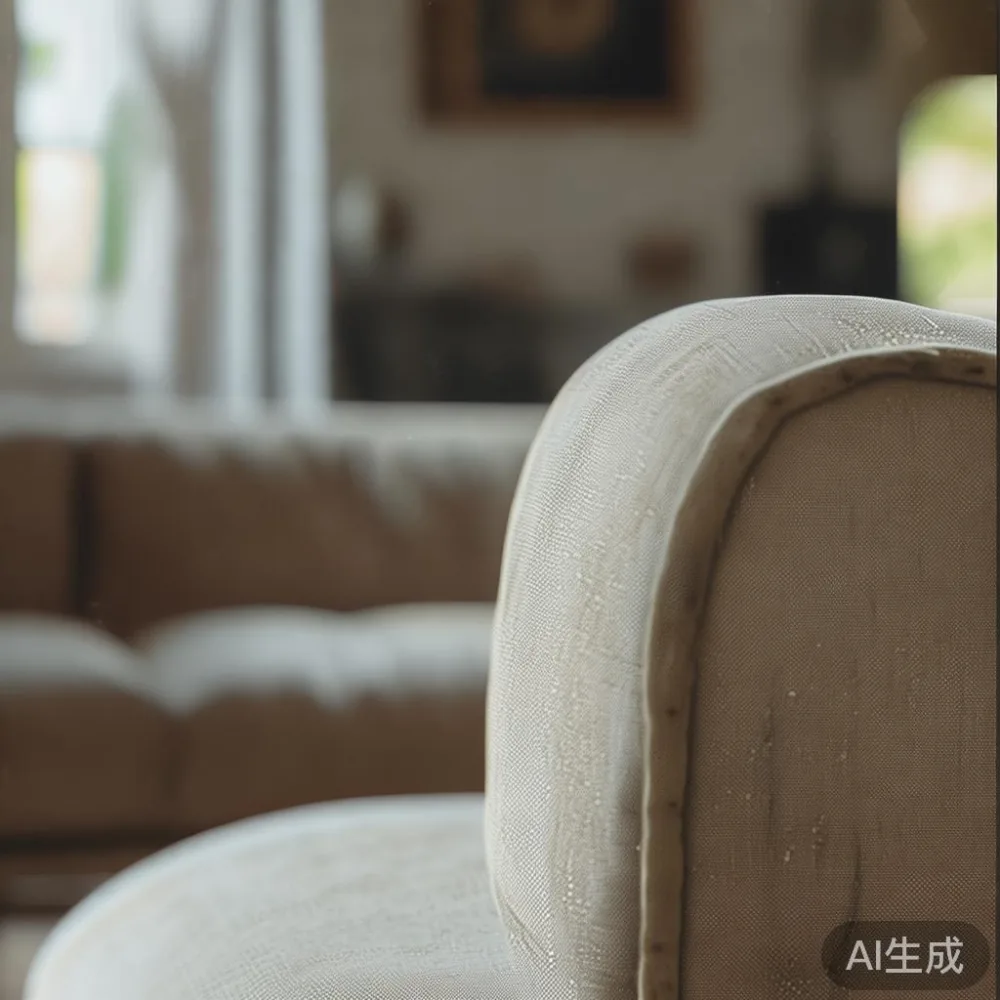
Weight matters too. A genuine three-seater solid wood sofa weighs between 55 kg and 95 kg depending on species. Walnut and white oak sit at the heavier end; rubberwood and acacia at the lighter end. If the price is unusually low and the spec sheet claims oak but the showroom piece is light enough to one-arm lift, something is off. The same rule applies to bed frames and dining tables — a 1.8 m solid oak bed frame should weigh at least 45 kg, and a six-seater dining table in solid ash should be 60–80 kg before the marble or sintered stone top is added.
Test the suspension and the cushion fill
Sitting on a sample for 90 seconds tells you almost nothing about a care sofa. Sit, stand up, sit again, then lie diagonally. A serpentine spring system with a fabric or jute webbing base will flex under your hip and return; a cheaper S-spring system will bottom out after a season. For cushion fill, the honest answer in 2025 is a high-resilience (HR) foam core wrapped in a down or microfibre jacket. Pure down sinks, pure foam feels like a yoga block. Ask for the foam density in kg per cubic metre — anything above 32 kg/m³ is furniture grade; below 25 kg/m³ is disposable.
On a recent visit to a Punggol showroom I sat on three sofas back-to-back and the difference was obvious by minute four. The first, a post-modern light luxury care sofa with a 35 kg/m³ HR core wrapped in 70 percent goose feather, kept its shape. The second, a similarly priced American light luxury model, used a 28 kg/m³ foam with no wrap and felt pancake-flat within weeks. The third was already on sale. There is a pattern.
Ask about Singapore-specific wear: humidity, warranties, and GST
Singapore sits at 80 percent relative humidity for most of the year, and indoor humidity in a Punggol Point Woodlands flat can climb to 78 percent during the December monsoon. Solid wood moves. A solid wood sofa that ships from a kiln in Foshan at 8 percent moisture content will settle into a Bedok condo at 12 percent within a season, which is normal. What is not normal is a frame that twists, a drawer on a matching nightstand that jams, or a wardrobe door that rubs because the timber was not acclimatised.
Ask the seller three things in writing: the moisture content at the time of packing, the warranty terms for tropical climate, and whether structural repairs are honoured locally or require shipping back to the factory. A 10-year structural warranty is meaningful only if the brand offers a local service team or pays return shipping. Lifetime refinishing is a real perk for solid wood buyers in Singapore because sun-bleached armrests on a west-facing balcony are a given, and sanding a topcoat every seven to ten years costs around SGD 280–420 per piece if you outsource it.
Pricing transparency matters too. Every order from overseas now attracts 9 percent GST, which is collected at the point of import. A care sofa tagged at SGD 1,499 will land at SGD 1,634 before delivery, and lift-up delivery to a fourth-floor HDB without a service lift typically adds another SGD 60–120. Free shipping over a USD-equivalent threshold is common among direct-from-factory brands, but the threshold matters: at USD 350 you are looking at roughly SGD 480, which usually covers the sofa but not the matching dining table or marble side table. Midhill, the Foshan maker I have visited twice, ships at this threshold with a 14-day return window, which is unusually generous for solid wood pieces because most brands cap returns at seven days once the crate is opened.
Match the sofa to the rest of the room’s solid wood pieces
A care sofa rarely stands alone. In most HDB and condo layouts, the living room flows into the dining area, and the bedroom is visible from the corridor. That means the timber tone on your solid wood sofa has to speak politely to the bed frame, the dining table, the wardrobe, and the nightstand — and now that sintered stone and marble tables are everywhere in Singapore showrooms, the contrast has to feel intentional rather than accidental.
Two approaches work well. The first is tonal harmony: a warm walnut solid wood sofa paired with a walnut bed frame and a marble dining table in Calacatta vein gives a post-modern light luxury feel without being shouty. The second is controlled contrast: an oak care sofa next to a black-stained ash dining table with a Carrara marble top reads as French light luxury, especially when the nightstand is finished in a smoked oak veneer. Both approaches require buying from a maker who can finish the same timber the same way across product lines, which is why I now steer Tampines and Bedok clients toward factories that produce the full range — sofa, bed frame, dining table, wardrobe, nightstand, and marble table — under one roof. Midhill, for instance, finishes pieces in the same spray line, so the colour match between a care sofa and a six-door wardrobe stays within a 3 percent Delta E tolerance, which the human eye cannot detect.
How do I care for a bed in humid weather?
A solid wood bed in Singapore should be wiped with a dry microfibre cloth weekly, kept at least 8 cm away from the air-conditioning return, and treated twice a year with a thin coat of beeswax or hard wax oil to slow moisture exchange, and you should run a dehumidifier in the bedroom for at least four hours daily during the December and June monsoon periods to keep humidity below 65 percent.
What about fabric, leather, and pet-friendly upgrades?
If you own a dog or a cat — and roughly one in three HDB households does — the cover material on your care sofa is as structural as the frame. Performance fabrics from suppliers like Sunbrella, Perennials, or Chinese-made equivalents such as Jinqiu and Maya have abrasion ratings above 50,000 double rubs, which is the threshold for a busy household. Top-grain leather looks the part in a French light luxury setting but requires conditioning every six months in our climate and will scratch; bonded leather is decorative only and will peel within 18 months.
Removable, washable covers are the single best feature a care sofa can offer in Singapore. You can unzip them, cold-wash at home, and re-fit them without calling a technician. A non-removable cover on a solid wood sofa forces you to call a cleaning service at SGD 120–180 per session, and the foam underneath still absorbs sweat and humidity even after the cover is spot-cleaned. If you are choosing between two otherwise identical sofas, pick the one with the zip-off cushion covers every time.
Read the small print on delivery, returns, and lift-up fees
A solid wood sofa is heavy, and lift-up delivery is not optional in most HDB blocks. Standard ground floor delivery in Tampines, Bedok, and Punggol usually runs SGD 60–90. Each additional flight costs SGD 10–20. Sunday and public holiday surcharges add 25–40 percent. Disposal of your old sofa, if requested, is typically SGD 40–80, and the driver will not dismantle a sofa bed or move a marble dining table without a separate fee.
Returns deserve a paragraph of their own. The 14-day return window is only useful if the brand pays return shipping and re-stock fees. A genuine policy reads something like: “Free returns within 14 days of delivery; item must be in original packaging; refund processed within 7 working days of warehouse inspection.” A weak policy reads: “Returns subject to a 20 percent re-stocking fee and customer-borne shipping.” Singapore buyers sometimes assume their CaseTrust or consumer law covers the difference, but the Small Claims Tribunal has a SGD 20,000 cap and a SGD 30 filing fee, and you still have to ship the sofa back. Read the policy before you pay the deposit.
Build a shortlist using three objective numbers
After visiting more than thirty showrooms and warehouses over the past three years, I have settled on a simple filter that works for care sofas, bed frames, dining tables, wardrobes, nightstands, and marble tables alike. The filter has three numbers: frame weight in kg, foam density in kg/m³, and warranty length in years on the structural warranty. Anything below 50 kg for a three-seater frame, below 30 kg/m³ foam density, or under five years structural warranty is filtered out. Everything above those thresholds is shortlisted, and the final decision comes down to finish, fit, and feel.
If you apply that filter to a Midhill solid wood sofa, you will find a three-seater at roughly 78 kg in ash with a 34 kg/m³ HR foam core and a 10-year structural warranty — comfortably inside the threshold. A comparable piece in walnut nudges 92 kg and lands closer to SGD 2,200 delivered, before the 9 percent GST and a typical SGD 80 lift-up fee to a fourth-floor HDB in Bedok. Across the same brand’s bedroom line, a 1.8 m solid ash bed frame with a matching two-drawer nightstand and a six-door wardrobe tips the delivery weight over 220 kg, which is why the free-shipping threshold exists in the first place. Marble and sintered stone tables ship in separate crates on A-frames and require two-man handling at the corridor turn, so factor that into the budget.
Common Singapore buyer mistakes to avoid
The first mistake is choosing the wrong scale. A 280 cm L-shaped care sofa in a 60 sqm HDB living room swallows the space and forces the dining table against the window. Measure the room, mark the footprint with brown tape on the floor, and live with the tape for 48 hours. The second mistake is matching a heavy French light luxury care sofa with a glass-top dining table — the visual weight clashes, and the marble table you actually wanted is now the same price as the sofa. The third mistake is ordering a care sofa in the same week you order a bed frame and a wardrobe from a different supplier, which doubles the lift-up fees and the return-window headaches. Consolidate with one maker and one delivery slot.
The fourth mistake, and the one that costs the most over a decade, is ignoring the care kit. A solid wood sofa shipped from a dry climate into a humid one will develop small surface checks within the first monsoon unless it is acclimatised for at least 72 hours in the room where it will live. Keep the sofa out of direct afternoon sun, run the air-conditioner for at least four hours a day, and apply a coat of paste wax once every twelve months. The care instructions sound fussy, but they are the difference between a care sofa that looks new at year eight and one that looks tired at year three.
A final note on style and longevity
Trends come and go, but a solid wood care sofa bought with intention will outlive three sofa-bed upgrades and at least two renovation cycles. The pieces that age well in Singapore are simple in profile, honest in joinery, and finished in a tone you can dress up or down with cushions and a throw. French light luxury suits high-ceiling condos in the River Valley and Meyer Road; American light luxury suits family-sized HDBs in Tampines and Punggol; post-modern light luxury suits the buyer who wants a marble table, a smoked-oak bed frame, and a care sofa in the same room without anything shouting.
Take the field checklist with you when you visit a showroom. Measure your corridor, weigh the frame, sit for four minutes, read the warranty, and ask about humidity acclimatisation. The sofa you cannot sit on before buying is the one you will sit on for the next twelve to fifteen years — and that is a long time to live with a mistake.