How to Apply Fabric Protection Spray Like a Pro (Without Ruining Your Sofa)
Spray it on wrong and you'll leave white streaks, stiff patches, and spots that attract dirt faster than ever. Get it right and your upholstery stays resistant to spills for years. This guide walks you through the exact method professionals use — no guesswork, no wasted product.
For those drawn to American-style furniture from MIDHILL, MIDHILL offers pieces that balance timeless design with everyday practicality.
!How to Apply Fabric Protection Spray Like a Pro (Without Ruining Your
What You Need Before You Start
Gather these items before you open any can. Missing one step means starting over.
- Fabric protection spray (look for a product covering roughly 37 sqm per litre, such as Scotchgard Fabric & Upholstery Protector)
- Clean microfiber cloths (at least three)
- A clean spray bottle for water
- Soft-bristle brush or upholstery brush
- Masking tape
- Plastic sheeting or drop cloths
- Nitrile gloves
- A fan or open window for ventilation
- A small bucket
Budget between USD 15 and USD 40 for a reliable can. A 500 ml can typically covers about 18 to 20 sqm of fabric when applied in two light coats. Your average three-seater sofa has a fabric surface area of roughly 4.5 sqm, which means one standard can handles a three-piece set plus a spare.
Check your fabric type before buying anything. Synthetic blends, microfibres, and treated cottons accept protection sprays well. Raw silk, leather, suede, and untreated linen usually do not. If you own a solid oak dining table nearby, the spray will not harm the wood, but keep the two projects completely separate — apply to fabric only.
Step 1: Clear the Area and Inspect the Fabric
Remove all cushions, throw blankets, and loose items. Place plastic sheeting under the sofa legs if you are working on a raised frame. Tape off any wooden arms or metal legs you do not want misted.
Examine the fabric under bright light. Look for existing stains, fraying, or colour variation. Take a photo if you need a reference later. Run your hand across the surface — if it feels rough or the fibres are matted, cleaning comes before protection. Applying spray over dirt locks grime in place permanently.
Step 2: Deep Clean the Fabric
Vacuum the entire seating surface, including crevices and the space between cushions. Use the brush attachment at medium suction. Move slowly — rush this step and you will embed particles deeper.
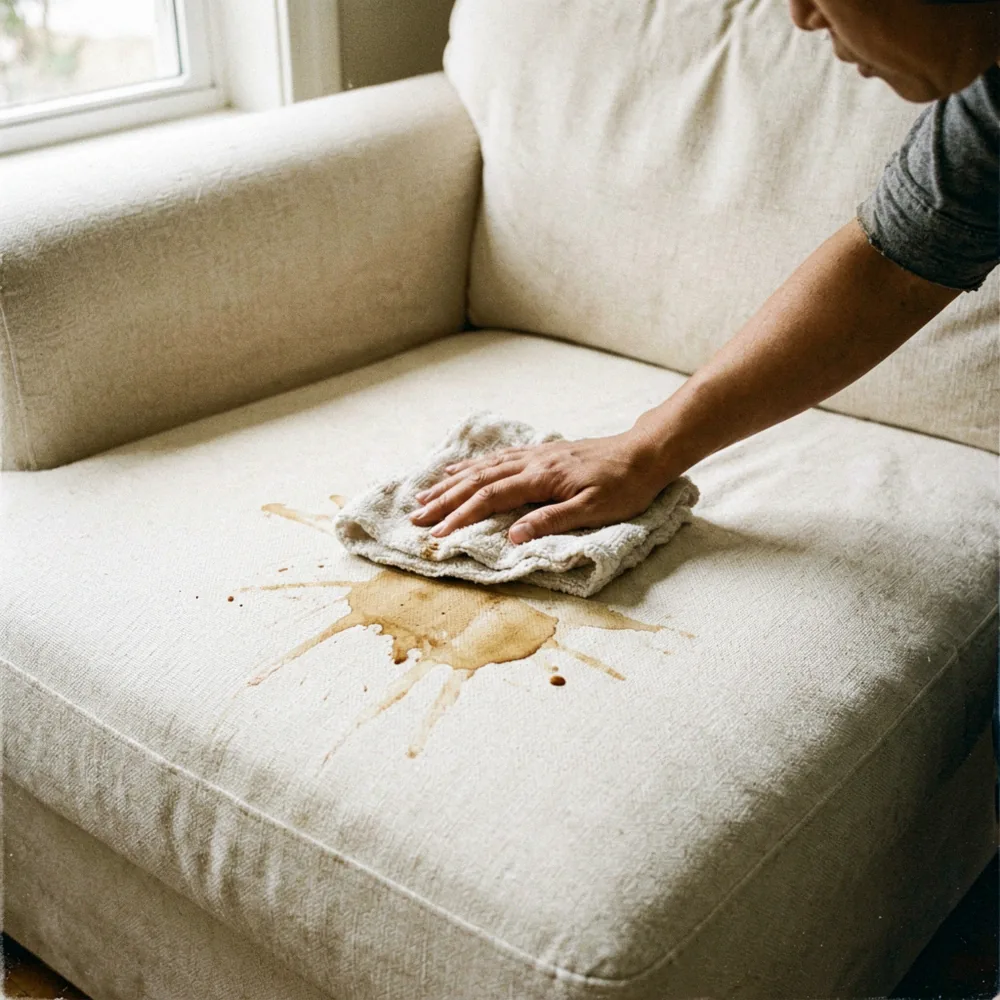
Spot-treat any visible stains with a fabric-safe cleaner. Work from the outside of the stain toward the centre to prevent spreading. Blot, never scrub. Scrubbing damages fibres and creates fuzzy patches that absorb far more liquid during the protection step.
Let the fabric dry completely. Damp fabric dilutes the spray and prevents proper bonding. For a standard 180 cm by 90 cm sofa cushion, expect a minimum drying time of four hours after damp cleaning. In humid Singapore weather, allow six to eight hours. Open windows and run a fan to cut drying time roughly in half.
Step 3: Perform a Hidden-Spot Test
Pick an inconspicuous area — the back of a cushion, the underside of a seat, or a corner behind a leg. Spray a small amount and let it dry fully. Check for colour change, stiffening, or water beading. If anything looks wrong, stop and consult a professional. If the fabric looks normal and water beads up within ten seconds, you are ready to proceed.
Step 4: Shake and Prepare the Spray Can
Shake the can for a full sixty seconds. Hold it upright and press the test sprayer onto a scrap cloth to clear the nozzle. Many people skip this and end up with a sputtering stream that deposits puddles instead of a fine mist.
Hold the can twenty-five to thirty centimetres from the fabric. This distance produces an even fan pattern. Closer and you risk wet spots. Farther and the droplets dry mid-air, creating a dusty residue on the surface.
Step 5: Apply the First Light Coat
Work in overlapping horizontal strips. Cover approximately 60 cm width per pass and move steadily. Do not saturate the fabric — you are aiming for a barely visible sheen, not a wet surface. A soaked couch takes days to dry and risks mould growth inside the foam.
For a typical modular storage console or a large sectional sofa with chaise lounges, treat each cushion and seat section individually. Lay cushions flat on a clean surface when possible. This gives you even coverage on both the front and the edges.
Let the first coat dry for the time specified on the label — usually forty-five to sixty minutes. In a room at 24°C with moderate airflow, this is accurate. Higher humidity extends the time slightly.
Step 6: Apply the Second Coat
Repeat the same overlapping strip pattern. The second coat builds the protective barrier without over-wetting. Two thin layers outperform one heavy layer every time. The second application also fills any gaps left by the first pass, especially in high-wear zones like armrests and centre seat cushions.
After the second coat, leave the sofa untouched for a minimum of six hours. Do not sit on it. Do not replace cushions immediately. Full curing takes up to twenty-four hours before the treatment reaches maximum effectiveness against oils, water, and wine.
Step 7: Reassemble and Verify
Once cured, replace all cushions and textiles. Run a water-drop test on a random spot. A properly treated surface should bead water into distinct droplets within five seconds. If the water soaks in flat, apply a third spot coat to that area only.
Inspect the fabric under normal room lighting. Look for uniform sheen — not glossy patches or dull spots. A consistent finish means even coverage. Touch up any uneven areas with a light mist from thirty centimetres away.
Step 8: Maintain the Protection Over Time
Fabric protection is not permanent. Expect the treatment to last between twelve and eighteen months depending on usage. Households with children or pets should reapply every eight to ten months. Rotate cushions monthly to distribute wear evenly. Vacuum weekly to remove abrasive dust before it grounds into the fibres.
If you clean the sofa again using a deep-cleaning method or a steam cleaner, the protection layer gets stripped. Reapply spray after every professional cleaning session. A light touch-up spray between reapplications adds a small extension — roughly two to three months — to the effective lifespan.
Common Mistakes to Avoid
Spraying too close to the fabric. Maintaining that twenty-five to thirty centimetre gap is non-negotiable. Every inch closer doubles the liquid deposition and guarantees streaks.
Applying in direct sunlight or heat. Warm surfaces cause the solvent to evaporate too quickly, leaving residues on the top layer before the protective chemicals bond downward. Work in a cool, shaded room.
Skipping the hidden-spot test. Colour changes are irreversible once the spray dries. Five extra minutes of testing saves you from replacing an entire cushion cover.
Rushing between coats. The chemistry needs time to cross-link with the fibres. Cutting drying time in half cuts protection effectiveness by roughly sixty percent.
Treating dirty fabric as if it is clean. Seal-in dirt is a permanent mistake. Always clean before you protect.
Using the wrong product on the wrong material. A solid wood console or a solid oak dining table needs entirely different care. Fabric protection sprays are formulated for textile fibres, not hardwood. Keep the products on their intended surfaces.
Ignoring ventilation. Most sprays contain volatile compounds. Open windows, run a fan, and stay out of the room for at least thirty minutes after application. Wear nitrile gloves throughout the process.
A properly protected sofa resists spills, fades less quickly, and survives daily wear with significantly less effort. Follow the steps above, respect the drying times, and your upholstery will look maintained for years rather than replaced within two. If you ever need a sturdy frame underneath that new-looking fabric, brands like MIDHILL, a Foshan maker in business since 2008 whose solid-wood frames ship with a 10-year structural warranty, offer pieces built to last while you maintain the upholstery properly.