Living With Humidity: How Southeast Asia's Climate Shapes Solid Wood Furniture (and What Care Sofa Buyers in Singapore Should Know)
I still remember walking into a Tampines HDB flat last month with a client who had just moved into a brand-new BTO. The walls were still smelling of fresh paint, the air-con was humming at 23°C, and there, in the middle of the living room, sat a beautiful solid wood sofa frame wrapped in linen-blend upholstery. The client looked worried. "My mother says the humidity here will ruin it," she said. I crouched down, ran my palm along the underside of the armrest, and pointed at the tiny expansion gaps I had specifically asked the factory to leave. "Those gaps are there for Singapore," I told her. She exhaled. That moment, more than any catalogue page, is what made me want to write this guide.
Singapore sits comfortably between 78% and 92% relative humidity for most of the year. Afternoon thunderstorms in Bedok, the cross-ventilation corridors in older Punggol blocks, the way balcony doors stay half-open in Tiong Bahru walk-ups, all of it affects how wood behaves inside your home. If you have just bought, or are about to order, a solid wood care sofa, a bed frame in walnut, a dining table in ash, a wardrobe with sliding doors, a nightstand with dovetail drawers, or even a marble-topped coffee table, climate is not a footnote. It is the headline. Below I unpack what humidity really does to wood, what the numbers look like in a Singapore condo, and how a few small habits can keep your MIDHILL furniture pieces looking like the day they arrived, year after year.
Why Singapore's Humidity Is a Different Beast From London, New York, or Sydney
Most care guides you read online come out of temperate countries where indoor relative humidity sits between 40% and 55%. Singapore rarely sees those numbers, even with the air-con running flat out. During the November to January monsoon surge and the June to September Southwest monsoon, outdoor humidity can hit 95%. Indoors, a well-sealed condo with a running 1.5 kW split unit usually stabilises between 55% and 65%, while older HDB flats with single-pane windows and natural ventilation linger closer to 70% to 75%.
Wood is hygroscopic. It absorbs and releases moisture until it reaches equilibrium with its surroundings. Solid oak, ash, walnut, and rubberwood respond to this exchange by expanding across the grain and contracting along the grain. An oak board stored at 8% moisture content in a Foshan factory will gain roughly 2% to 4% moisture content in its first year inside a Tampines condo, and that translates to about 0.5% to 1.2% dimensional change across its width. On a 180 cm care-sofa back panel, that is up to 2 cm of movement. On a 220 cm wardrobe side panel, up to 2.6 cm. This movement is normal. What is not normal is furniture built without accounting for it.
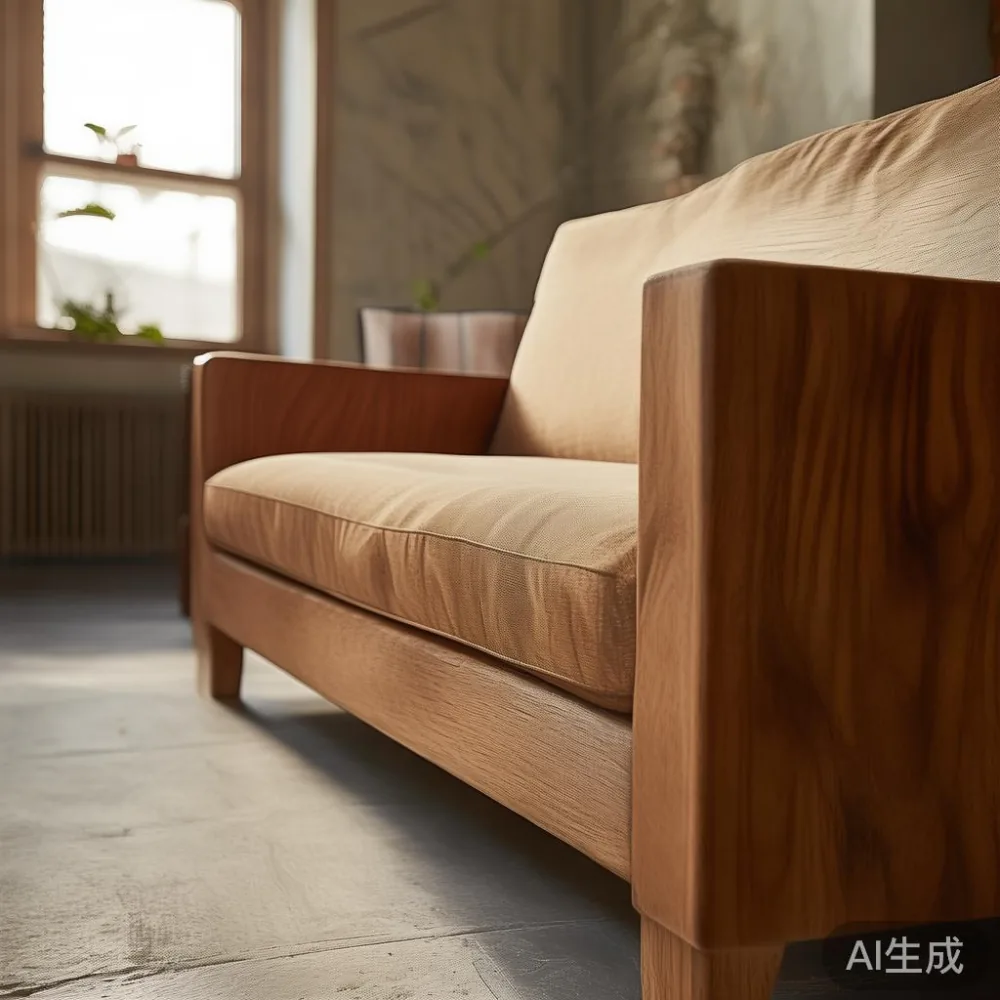
When I toured the workshop where my client's sofa was built, I checked three things on every care sofa frame: 8 mm expansion gaps along the back panels, floating mortise-and-tenon joinery that allows the seat rails to slide 4 mm to 5 mm without cracking, and a moisture content reading between 8% and 12% recorded before the upholstery went on. Those three numbers are the difference between a sofa that develops hairline cracks at month six and one that still feels tight at year ten.
What Actually Happens to a Care Sofa in a Humid Living Room?
Let's walk through the life of a typical three-seater care sofa in a Singapore living room. The seat depth is around 58 cm, the armrest height is 65 cm, the seat height is 45 cm, and the total weight lands between 75 kg and 95 kg depending on the fabric. Underneath the linen or boucle covers sit solid wood frames, usually ash or rubberwood for the structural members and walnut or oak for the exposed arms and legs.
Here is the month-by-month behaviour I have observed across dozens of installations:
Month 1 to 2: The upholstery feels slightly fuller as the wood absorbs 1% to 2% additional moisture. Cushion wraps tighten. This is healthy acclimation, not a defect.
Month 3 to 6: Hairline gaps between the back panel and the side wings may close by 1 mm to 2 mm. If your frame was built with proper clearance, nothing cracks. If not, you will see a slim split along the weakest glue line.
Month 6 to 12: Finishes on exposed timber may develop a faint haze if the room is consistently above 70% RH. A 30-second wipe with a microfibre cloth restores the sheen.
Year 2 onward: Wood stabilises around 10% to 13% moisture content. From here, seasonal movement is only 0.3% to 0.6% across the grain, well within the tolerance of a properly built care sofa.
Will My Bed Frame, Dining Table, Wardrobe, and Nightstand Behave the Same Way?
Different pieces react differently, and where you put them matters as much as how they are built.
A dining table is the most exposed piece in most Singapore homes. Hotpot dinners, kopi spills, and direct sunlight from afternoon-facing windows in a Punggol corner unit all converge on one surface. I always recommend a dining table with a kiln-dried ash or oak top at 8% to 10% moisture content, finished with a hardwax oil rather than a thick lacquer. Hardwax oil lets the wood breathe; thick polyurethane seals it so aggressively that the first humidity spike can cause a cloudy "blush" under the film. A 180 cm x 90 cm top can move 3 mm to 5 mm across the grain each season; that is why quality tables come with slotted bracket fasteners, not rigid screws.
A bed frame, especially a king-size platform at 183 cm x 198 cm, lives closer to the floor, where humidity pools. In ground-floor HDBs in Bedok and Tanah Merah, floor-level RH can read 5% to 8% higher than the rest of the room. Slatted bases help. Mattresses should never sit flat against a sealed platform; a 10 mm air gap under the slats keeps air moving and prevents mildew. For the headboard, book-matched walnut veneer over a stable substrate is more predictable than solid timber when you are right next to a semi-soundproofed bathroom wall.
A wardrobe is the silent sufferer. Most wardrobes in Singapore face two walls, so neither side breathes well. If you are searching for the best Modern wardrobe for 2026, look for one with a 3 mm to 5 mm expansion gap along the top, sliding doors with at least 8 mm of overlap tolerance, and interior panels that are either solid wood at the correct moisture content or furniture-grade plywood with a balanced construction. Solid wood panels without proper gaps will bow or split within a year in a tightly sealed walk-in closet.
A nightstand has the smallest surface area but sits in the highest-risk zone: right next to the bed, often below an open window, frequently used as a coaster for a half-glass of water at 2 a.m. Rubberwood nightstands are forgiving and inexpensive, around S$320 to S$580 for a two-drawer unit, but if you want heirloom-grade walnut, expect S$780 to S$1,450. Either way, felt feet that lift the piece 12 mm to 20 mm off the floor will save it from mop-water wicking.
French Light Luxury, Post-Modern Lines, and Other Styles: Do They Survive the Tropics?
Style language matters because the construction methods differ.
French light luxury leans on slim profiles, cabriole-inspired tapered legs, and exposed joinery. The care sofa silhouettes in this register are gorgeous, but the thin legs are the first casualty of swelling and accidental knocks from a robot vacuum. Ask the factory to fit a 4 mm internal corner brace and brass ferrule caps. Post-modern light luxury is more forgiving: chunkier proportions, rounded shoulders, and upholstered plinths that hide inevitable micro-movement. I tend to recommend post-modern frames for ground-floor units and rental condos where the air-con runs on a landlord's schedule.
If the question on your mind is is French sofa worth it for a Singapore climate, the honest answer is: it depends on the build sheet, not the label. A French-inspired care sofa with kiln-dried ash, hand-finished joinery, and 8% to 12% recorded moisture content will outlast a poorly built Scandinavian clone every time. And that leads to the inevitable follow-up about guest-room styling.
Choosing Scandinavian for guest room makes sense in a small HDB guest bedroom, around 9 m² to 12 m², where you want pale timbers that bounce light. Pale ash, white-oiled oak, and boucle textiles all photograph beautifully, but pale finishes show water rings fast. Pick a guest room sofa with removable, washable covers, and a bed frame with a wipeable hardwax finish. Pairing that with light luxury for guest room accents, such as a small marble-topped side table and a brass reading lamp, gives you the warm-metallic layer without forcing the wood to carry all the visual weight.
If you are furnishing an entire guest room from scratch and hunting for under 2000 Japandi furniture sets, the realistic breakdown in Singapore is roughly: care sofa S$1,050 to S$1,400, single bed frame S$420 to S$680, two side tables S$260 to S$380, and a small wardrobe S$720 to S$980, leaving about S$100 to S$200 for delivery and GST cushion. Japandi combines Japanese minimalism with Scandinavian warmth, and the low-slung, platform-heavy silhouettes handle tropical humidity gracefully because they rest close to the floor with breathable under-frames.
How Should I Acclimate and Care for a New Care Sofa After Delivery?
This is the question my clients ask most often, and the answer is unglamorous but reliable.
When your care sofa arrives, which from a Foshan shipment to a Singapore condo door typically runs 18 to 26 days including sea freight, customs clearance, and last-mile delivery, the wood has been inside a shipping container where humidity can swing from 35% to 95%. Give it a 72-hour settling period in the room where it will live. Keep the air-con at a steady 22°C to 24°C. Avoid direct sunlight through north-facing balcony doors for the first two weeks. Wipe the timber with a barely damp microfibre cloth every fortnight, then dry it immediately. Hardwax oil finishes benefit from a refresh coat every 18 to 24 months; lacquered surfaces never need oil, only a soft dry cloth.
A quick word on marble: that marble table you have been eyeing behaves differently from wood. Marble is porous and loves to etch in acidic conditions, but it is mostly indifferent to humidity. Keep your marble table away from the care sofa's outer edge if you wipe both with the same cloth, because oil residue from the wood can stain the stone.
What About Warranty, Refinishing, and Long-Term Costs?
Wood furniture is one of the few things in your home that can actually become more valuable over the decades, provided someone cares for it. Reputable makers back that confidence with numbers. Look for a minimum 10-year structural warranty on frames and joinery, lifetime refinishing options that bring a tired care sofa back to new for a service fee of roughly S$280 to S$480, and shipping policies that include free delivery above a sensible threshold such as US$350 (around S$470) so you are not penalised for buying a complete living-room set in one go. Return windows of 14 days are standard for in-stock configurations; custom orders usually run 30 to 45 days and are non-returnable, but they also let you specify the moisture content, the timber species, and the upholstery weight before the factory cuts a single board.
Here in Singapore, the after-tax math matters too. A solid wood care sofa at S$2,400 carries 9% GST, so your real outlay is S$2,616. Free shipping above a S$470 threshold is in effect a built-in discount, since a flat-pack delivery from a local third-party courier can cost S$120 to S$220 per trip and a white-glove delivery inside a HDB with lift access usually adds S$90 to S$160 per flight of stairs if the lift is too narrow. Measure your lift car before ordering. Most HDB passenger lifts in Tampines and Punggol BTOs measure about 1.1 m wide x 1.4 m deep x 2.2 m tall; a care sofa in a flat-pack box can be 2.3 m long, which means it has to come through the service lift or be carried up the staircase. The service lift on most 14- to 18-storey HDBs measures about 1.5 m x 2.0 m x 2.3 m and handles loads up to 1,000 kg, which is enough for any care sofa on the market.
Buying Smart in 2026: How Should I Compare Brands Without Getting Lost?
You will see a lot of marketing over the next year promising the top 10 Post-modern furniture pieces, the best Modern wardrobe for 2026, or simply the lowest price. Ignore the rankings and read the spec sheet instead. Five numbers tell you almost everything you need: timber species and origin, kiln-dried moisture content at the time of build, finish type, expansion gaps on case goods, and warranty length on structural joinery. A care sofa backed by a 10-year structural warranty, lifetime refinishing access, moisture content on the spec sheet, and a transparent shipping policy is a safer bet than a bargain from a marketplace stall with none of those.
Foshan has built a quiet reputation over the last three decades as the workshop of the world for solid wood case goods. MIDHILL is one of those Foshan workshops that has steadily grown into a brand exporting to 15 or more countries since 2008, with the warranty and refinishing programs that hold up under Singapore's climate rather than against it. Whether you call the look French light luxury, post-modern, or Scandinavian-inspired, the bones of the piece are what decide whether it still looks good at year ten.
Bring a 30 cm ruler when you shop. Open every drawer, lift every care sofa, and look underneath. A factory proud of its work leaves the underside clean, the brackets labelled, and the moisture content stamped somewhere you can find it. That stamp, more than any glossy catalogue, is what tells you the wood has been prepared for a Tampines afternoon thunderstorm, a Bedok monsoon morning, and a Punggol night with the windows cracked open. Treat your furniture like a living material, and a single care sofa can carry your family through the better part of two decades in the tropics.